Friday, April 5, 2013

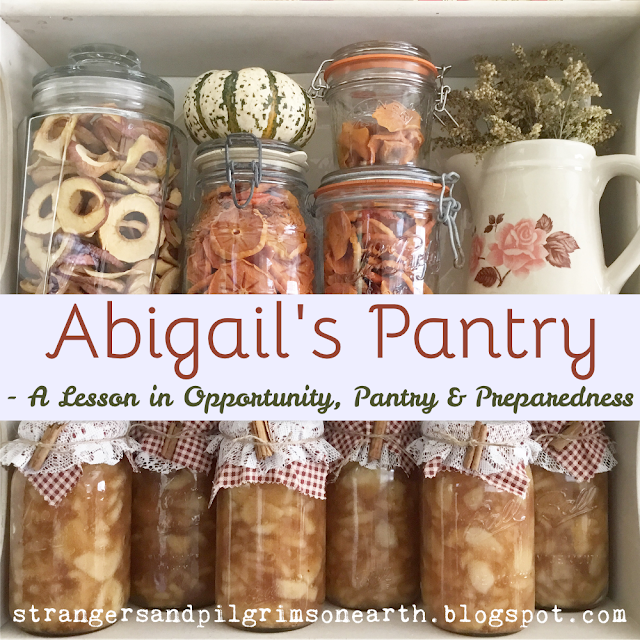
Simple Steps to Preparing a Pantry ~ Pantry Series


"Laura returned to the front room... She knew it must be the pantry door, but she stood in surprise and then in delight, looking at the pantry. All one wall was covered with shelves and drawers, and a broad shelf was under a large window at the pantry's far end…

One whole wall was shelved from the ceiling halfway down. The upper shelves were empty, but on the lowest was a glass lamp… At the end, where this shelf was above the window shelf in the corner, stood a row of cans of spices. 

Beneath this shelf were many drawers of different sizes. Directly below the spices, and above the window shelf, were two rather narrow drawers. Laura found that one was almost full of white sugar, the other of brown sugar. How handy!

Next, a deep drawer was full of flour, and smaller ones held graham flour and corn meal…"

~ Laura Ingalls Wilder, These Happy Golden Years


How I appreciate a well organized pantry, one that is loved with it's orderly arrangement while providing the family with nourishing meals! It speaks to me of preparedness, blessings, sustenance and provision. When properly maintained, it is like a private grocery store located in your own home *dreamy sigh*.

Here are some ways to get started (from easiest onward):
  • The first simple step which requires little work but some investment is to build up a surplus of dry goods.  By simply storing bulk grains, you are that much more prepared for a rainy day. This is also very cost efficient since you won't be paying for all the individual, small portion packaging. (Here is our printable "stock your pantry" list.)
  • The second step is to stock up on items that you use often when they are on special. Just make sure your family will be able to finish the products prior to their expiration dates. For example, a surplus of whole canned tomatoes, honey, certain oils and vinegars will always be a good thing because of their variety of uses and excellent shelf life.
  • The third step which requires some time and effort is to plant a garden and preserve the abundance by freezing, fermenting, drying and canning your own food. If you can make goals for yourself during the harvest to put up at least one batch of food per week, you will be building up an inventory and your grocery store bill will start to decrease.
  • Do you have any fruit trees on your property (or a does a family member and/or friend)? We have our fig trees that we make into jam, our pomegranate trees that we juice and freeze in ice-cube trays for smoothies, etc… Our neighbor gives us loads of lemons when they are season. Here is what we did with them to increase our pantry inventory. I think you get the idea. Create items for your pantry using your own resources. Don't buy these products when you can produce them frugally. 
  • The final step is to forage your fields and see what wild plants you can preserve and utilize (this is something to do when your garden is not producing). For example, we have loads of chamomile flowers (soothes stomach and nerves) and stinging nettles (excellent for allergies) which can be dried, stored in jars and used for tonics, teas and tinctures. We also have lavender plants which we use in many ways. Be resourceful with what you have to increase your provisions without spending a dollar!

Remember that the better stocked you are, the least you have to grocery shop because…

“The odds of going to the store for a loaf of bread and
coming out with only a loaf of bread are three billion to one.” 
~ Erma Bombeck


Wednesday, April 3, 2013

Prepare Your Own Pantry ~ Introduction and Index to Pantry Series


"And such a pantry! Laura was so delighted with the pantry that she stood in the doorway for several minutes, admiring it."
~ Laura Ingalls Wilder, The First Four Years

As our family is purchasing more in bulk to save money, broaden our food storage supply and avoid weekly grocery store runs (thus saving money on gas), this means a reorganization of our pantry space (and this new series). Here are some posts to encourage you to be purposeful and create a well stocked pantry. To begin, we are sharing our favorite 10 Reasons to Prepare a Pantry and Some Food "Storage" for Thought!


And finally, if you are interested in how to turn your pantry into a homemaking hobby, visit here. We also share suggestions on how to create a pantry space when you haven't one. Other links of interest may be our Prepare Your Own Pantry/Products ~ An A - Z Index and Making Your Own Medicine with Pantry Provisions. And if you would like some recipes for building up your pantry, visit here

Friday, March 29, 2013

The Passover Lamb ~ Past and Present


"The next day John seeth Jesus coming unto him, and saith,
Behold the Lamb of God, which taketh away the sin of the world."
~ John 1:29

"But oh! how shall we, how shall any, escape this righteous, this awful judgment (of God)? How can God's justice and His mercy be reconciled in His dealings with us poor sinners? How can guilt be punished, and yet the guilty be spared? This is the great mystery of our redemption — the mystery which Divine Wisdom alone could solve. The just shall live by faith (Romans 1:17): the whole gospel scheme of salvation rests on this solemn truth. That we may understand something of its meaning, let us proceed to consider the last of the ten judgments upon Egypt — the destruction of the first-born — and behold by what marvellous means God's people were preserved from sharing the fate of His foes. Here we may behold as in a picture the way — the only way — by which we can escape eternal destruction. Oh, may the Spirit of God open the eyes of our understanding, that in the Passover Lamb devoted to death we may see a type of the Lamb of God that taketh away the sin of the world (John 1:29); that in the blood which, sprinkled on the door-posts, made the destroying angel pass, we may behold foreshadowed the blood of Jesus Christ, which cleanseth us from all sin! 

Moses said, Thus saith the Lord,  About midnight will I go out into the midst of Egypt, and all the first-born in the land of Egypt shall die. In that land dwelt the children of Israel, even as God's people now dwell in the midst of a guilty and sentenced world. The Israelites could have devised no means of keeping the destroying angel from their homes. God himself provided a remedy: all that was needed on the part of His redeemed ones was faith and obedience to apply that remedy. Moses commanded the congregation on the tenth day of the month Abib — which corresponds to our March and April — to take a lamb for each household, a lamb without blemish or spot, and slay it on the fourteenth day of the month. They were to eat that lamb in the night ; roast with fire, with bitter herbs and unleavened bread should they eat it: and take of the blood, and strike it on the two side-posts and on the upper door-post of each house wherein the holy feast should be prepared. It is the Lord's passover — such was the message from the Most High — for I will pass through the land of Egypt this night, and will smite all the first-born in the land of Egypt… I am the Lord: and the blood shall be to you for a token upon the houses where ye are ; and when I see the blood I will pass over you, and the plague shall not be on you to destroy you (Exodus 12:11-13).

We are not left in any doubt as to the typical meaning of this passover, this solemn feast and blood of sprinkling. I need but refer you to the inspired words of the Apostle Paul in reference to the death of the Saviour: Christ, our Passover, is sacrificed for us, therefore let us keep the feast ; not with the old leaven, nor with the leaven of malice and wickedness, but with the unleavened bread of sincerity and truth (1 Corinthians 5:7-8). It was not without the special ordering of God that the time of the yearly celebration of the passover should be chosen for that on which the Son of God shall suffer. "In the same month, on the same day, and at the same hour in which the Israelites were ordered to kill the Lamb," the Lamb of God expired on the cross! His blood, sprinkled through faith on the heart, is to the soul what the blood sprinkled on the door-posts was to the body — it saves, and it alone can save.

Thus is it with us, my friends. Our Christian name, our Christian privileges, nay, our works of charity and love, cannot save us in the great day of wrath. There is but one appointed means of salvation — faith in the atoning blood of the Lord.

And again, see how faith wrought obedience. Had the Israelites said that they believed the word of Moses, yet had neglected or delayed to obey his directions, - where had been the use of such lifeless faith? With them faith and obedience were closely united; as it is written in the Scriptures — The people bowed the head and worshipped; and the children of Israel went away, and did as the Lord had commanded (Exodus 12:27-28)."


~ by A.L.O.E., Excerpt from Rescued From Egypt, 1866


Wednesday, March 27, 2013

Free Lavender Plants From Cuttings Using An Existing Plant


To think I used to buy lavender plants when I already owned one! I try not to dwell on it. The truth of the matter is, all you need is access to a mature lavender plant, some scissors and soil, and you have new plants already! Spring and fall are the best times to propagate lavender.


Cut a tender piece (about 4 inches long) from the lower part of the plant, specifically one that hasn't bloomed (you don't want any flowers on your cutting). You also do not want a thick, woody, mature cutting.


Remove the bottom third of the leaves. (Edited to add: After I prepared this post, a family member who is an agronomist shared that I would have even better results if I left only the upper 1/3 of the leaves on the cutting.)


Insert cutting in a pot of healthy soil, making sure there are drainage holes at the bottom. Keep plant moist and place indoors, near a window for light. Continue to keep it moist but do not over water. When you notice some obvious growth (about a month's time or more), and the weather is acceptable to the plant, then you can either give it away as a lovely gift or plant in your own yard.


A week before you intend to transplant, you will want to get them acclimated by giving them a few hours of sun time each day. I was impatient and didn't do this.  At the beginning, my plants wilted a bit and I thought they may not make it. I had to place a laundry basket over them during the hot hours and they eventually sprung back to life. 


Plant in the early morning or late afternoon in a sunny spot when weather is cooler. Give it plenty of water.


The reason I love lavender is that it is beautiful, fragrant, medicinal, has a variety of uses, is heat resistant, doesn't require a lot of water and therefore low maintenance.

Note: The picture above is the same plant a few months later. We expect to have blooms the following year.


What other plants will this method work for? You can try doing this with lemon verbena, chamomile, rosemary and sage for starters!

You may also be interested in What to Make and Do with All Your Lovely Lavender. The Chick n' Coop shows us how to make lavender sugar and lavender goat's milk soap. And that is just to name a few... I will be sharing many more lavender related projects in the future because we are in love with this pleasing plant.

"And because the breath of flowers is far sweeter in the air (where it comes and goes, like the warbling of music) than in the hand, therefore nothing is more fit for that delight than to know what be the flowers and plants that do best perfume the air."
~ Bacon