Showing posts with label Home Design/Organization. Show all posts

Friday, September 16, 2022

How to Make a "Homespun" Preserving Notebook

“There was no rest and no play for anyone now. They all worked from candle-light to candle-light. Mother and the girls were making cucumber pickles, green tomato pickles, and watermelon rind pickles; they were drying corn and apples, and making preserves. Everything must be saved, nothing wasted of all the summer’s bounty.”
~ Laura Ingalls Wilder, Farmer Boy

I used to keep my canning recipes in my recipe book but the more recipes I accumulated, the less space I had for the seasonal canning ones. Then I switched them to my herbal but that also grew in size. This summer, I began gathering all my canning notes, recipes, etc., and placing them in their own dedicated binder. I call it my "Preserving Notebook".

After much deliberation (yes I think hard on such things 🤓), I decided to use alphabet tabs (affiliate link) to organize everything. That way, any canning recipe would have a home alphabetically. Apple recipes would go under “A”, blueberry recipes under "B", strawberry recipes under “S” and so forth. I also inserted a few other things that are useful to my preserving needs.

Here is what I included in my notebook:

(These first few items I keep in the beginning of the binder, prior to the tabs since they don't fit a certain "produce" theme. I consider them informational.)

- my food preservation planner pages (free printable here) In the autumn and winter months, as I go through my canning books, I make note on the recipes I would like to try. I input the recipe, book and page number in my planner pages. That way, when the season hits, I already know what I want to make with a certain fruit or vegetable. It is very useful. 

- pressure canning instructions (I don’t do it enough to rely on my memory so these steps are helpful and always conveniently located) I keep these at the front of the index tabs and have it covered in plastic as I take these in and out more. I copied these directions from The Prairie Homestead where she gives a great in-depth tutorial on how to use a pressure canner. Here is the link in case you are interested.

- pressure canning vegetable and meat charts (with time and pressure amounts) These I photocopied from the pressure canner manual (not shown).

- preserving articles I read from the canning authorities and find useful (such as “how to can without sugar or salt”, etc.) Here is the link in case you are interested in this particular one.


(The remaining items I insert in the tabbed section according to the alphabetical order of the produce I am preserving.)

- photocopies of my favorite recipes from my canning books (this way I don’t have to search them out), any handwritten recipes and so forth. Of course, these are placed alphabetically by "produce".

- themed recipe articles from State extension offices (they’ll have printable pages on how to preserve foraged fruits, etc., and list various preserving ideas and recipes which are very handy - here is a sample of the foraged fruit and here is the how to preserve peppers booklet that I included as well)

- individual preserving recipes I print from websites (once again these are placed in alphabetical order according to what is being preserved) Here is the apple pie filling recipe I use. I did do some fall decorating on the page as it was a little bland :)

- fruit leather recipe (here is the one I printed out from Chocolate Box Cottage) Something like this I would file under "F" for "fruit" in general.

- any food preservation recipes in general (including freezer jam recipes, fermenting recipes, dehydrating, etc.) Here are a few from my blog which may be printed for your notebook:

(All my food preservation tutorials are shared HERE but all do not include printable recipes.)

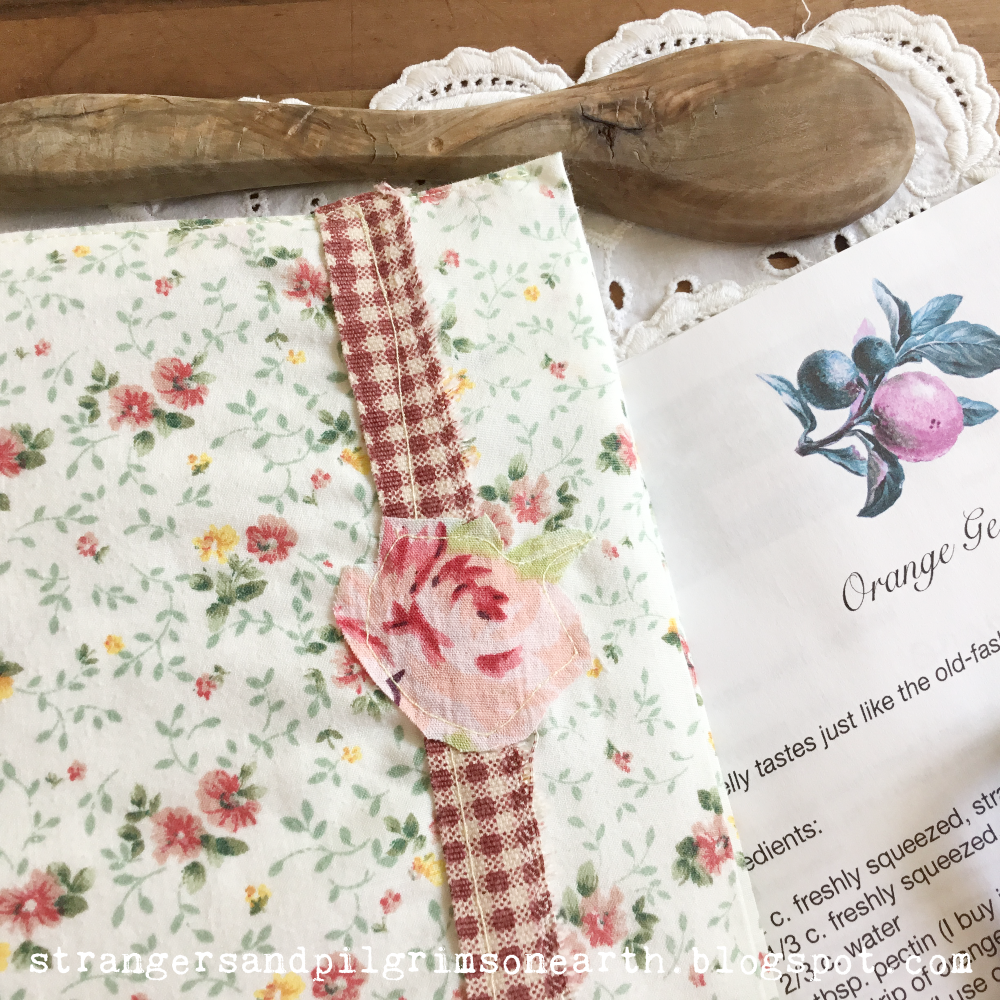
To add interest, I covered my notebook with a floral fabric to give it a cozy feeling. I am quite embarrassed to show this up close as I am not a great seamstress and quite an impatient one. I just used the remnant fabric from an old sheet (which had lots of piling but was still a cute print). I used the remnant gingham border from another project as ribbon (it still had a frayed side but I thought it added to the charm). Next, I cut off a rose from a retired duster-housedress and used that as a little embellishment. I also added a strip of lace to the back cover for more interest (pictured below).  I made the cover in the same way we used to have to cover our school books but used fabric instead of a paper bag. And I used a sewing machine instead of tape. It took 10 minutes to make because I obviously did it quickly (to be honest, I was supposed to be doing something else that day and I was feeling quite guilty for making this!).

I’ll be fine-tuning my binder over autumn as our garden has faded and I’ll have extra time to work on such projects. In fact, as I was typing this up, I thought I would add a food dehydration chart to this. I am always looking up the degrees and length of time for each piece of produce and it would be nice to have it handy here.

This project cost me a total of $3.76 because I had to purchase the alphabet tabs. Everything else was used from foraged materials around the house. This is a great way to use an old, ugly binder since you can cover it. Do you think you would ever make something like this? How do you store and keep track of your food preservation recipes? Is there anything else you would place in this binder? Please share!

Happy homemaking,

♡ JES


Tuesday, August 2, 2022

Spring 2022 Homemaking Newsletter

“She thought to herself, "This is now." She was glad that the cozy house, and Pa and Ma and the firelight and the music, were now. They could not be forgotten, she thought, because now is now. It can never be a long time ago.” 
~ Laura Ingalls Wilder, Little House in the Big Woods

Dear reader, I've been trying to embrace the “now” with my family and any other blessings that come along. Trying to glean the good in our lives when so much seems to surround us which isn’t… I’ve been busy making and preserving memories as well as making and preserving the seasonal produce. This is our family’s “now” and it’s very important they are taken care of and loved throughout whatever is going on in the world. These moments are their memories. As homemakers, we must continue to glean in the good of today as much as possible. The household depends upon it. 

“This is the day which the Lord hath made;
we will rejoice and be glad in it.”
~ Psalm 118:24


Welcome to the Spring 2022 edition of the Homemaking Newsletter. Yes, it HAS happened again that I didn't keep up with the monthly update! I'll try to condense it so this doesn't take up too much time to read. This is a place in which we chat about homemaking happenings and any other ponderings which do not fit into its own post. It is simply some old fashioned, Titus-2 chit-chat... would you like to join in?


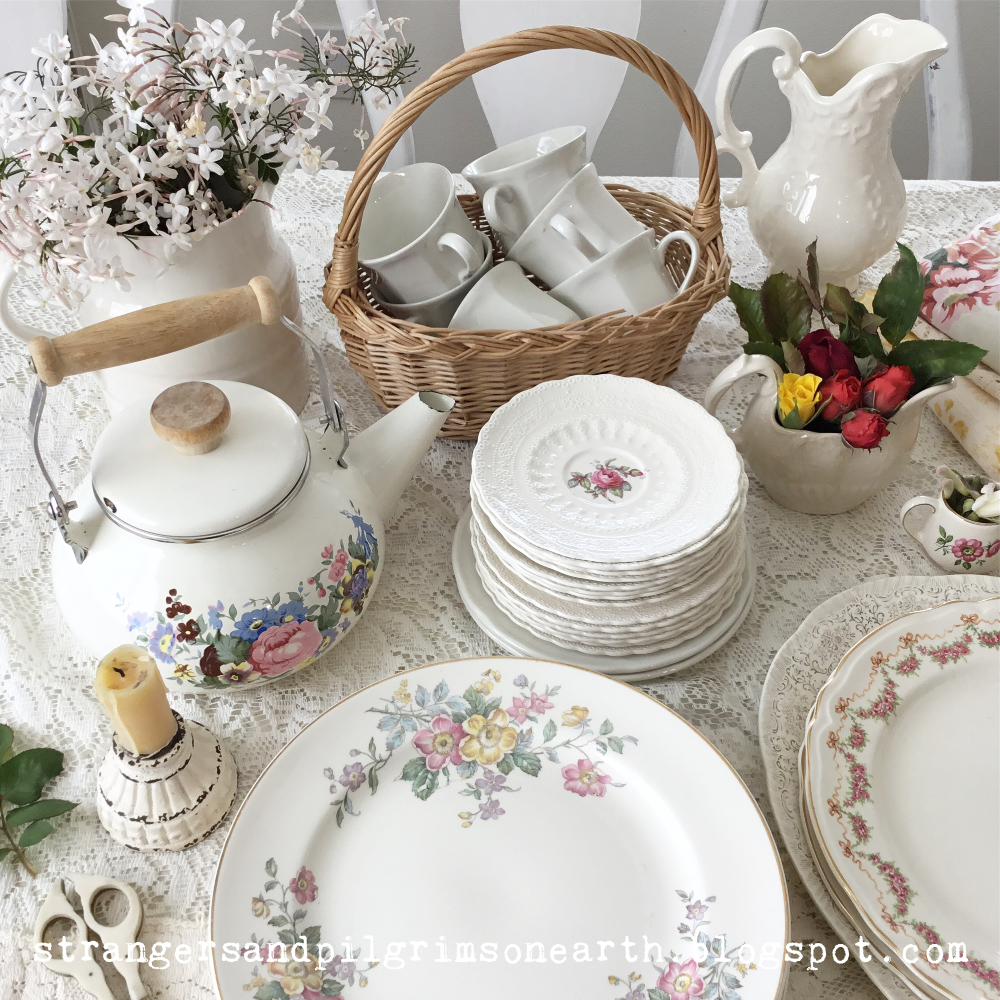
To begin, I’ve planted many beautiful blooms throughout my home this spring and none of which require water. There are floral bouquets on teapots, rose-vined plates and sweet bud saucers. I have infused these flowers into my home to make my own version of an indoor spring garden. It’s brought a lovely change which keeps the seasons special:

- I’ll be using my thrift-store collection of floral mismatched dishes and ironstone tea cups. 

- The snowy scene plate on the wall will be replaced with a vintage bouquet printed platter. 

- I’ve brought out this sweet floral tea kettle (which I’ve been holding onto until spring!) from a yard sale. I skipped home with it for $1. 

- I have brought out my little cream candlestick holder. Just one for spring to bring a gentle flicker to our evening meal.

- I’ve put our foraged pinecones and other winter elements away and will fill every pitcher and creamer I have with homegrown flowers all through spring and summer. I love to surprise my daughter with mini bouquets in her room.

- I’ve brought out my light colored tablecloths for a softer background for my dishes. 

- I’ve changed out my darker duvet cover to a soft floral one. It feels so fresh in the bedroom!

- I placed my spring inspired (thrifted) fabrics in a basket to serve as a reminder to sew some projects for the home (some are shared below).

- And lastly, the front door has been opened and there is a beautiful breeze. The windows, cleaned and sparkling, allow the freshness of the season to cleanse the air.

“Lord, I have loved the habitation of Your house,
And the place where Your glory dwells.”
~ Psalm 28:8


“That womanly tradition of making ordinary objects serve double duty as things of beauty is alive and well in many a household and is constantly expressing itself in new ways.”
~ Emilie Barnes

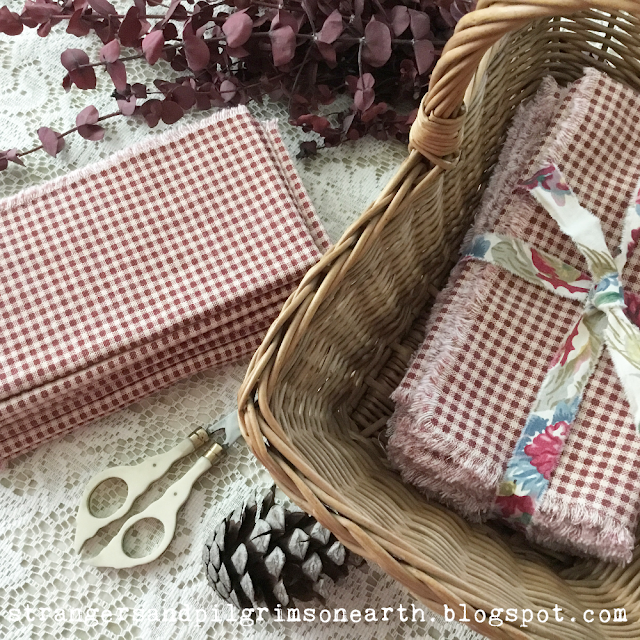
I repurposed a thrifted tablecloth into “spring cottage” napkins (without sewing). Once again, I’ve implemented this simple “snip-and-rip” process. I’ve made a set for summer, autumn and winter and was therefore obligated to do spring! For a $3 investment, I was able to make 24 napkins with a bit of leftover scraps for future fun. This set of napkins took me five minutes to measure and rip-to-size along with a few slow evenings spent pulling off excess threads. Here is the tutorial link if you are interested.


I also enjoyed repurposing a damaged tablecloth into “cottage” dish cloths…

I remember when I was younger, when I needed a change of pace, I would head to Target or someplace like it. It seemed harmless to go, however a trip to Target meant to $pend at Target!

But as I aged, the wall to wall shelves of mass produced items made me dizzy. There is no end. The manufacturers keep making and we keep buying and it’s exhausting to keep up!

So one day, I stopped trying. 

When I desire that “change of pace”, if it isn’t a thrift store, it’s my little closet of “potential” treasures that I go to. A place where I store pretty linens I inherited, scraps of fabric that are too lovely to let go of, attractive papers and other beautiful bits and bobs I’ve collected that may be transformed into something one-of-a-kind “one day”.

On one such visit to my little nest, I retrieved this vintage terry-cloth tablecloth which was full of holes (it was given to me by a faraway friend who knew I adored the print). I went through my homemade haberdashery (will share about that soon) and decided on just the project! 

It may seem a bit odd to make something so basic but I find it very enjoyable to use pretty things in my daily tasks. And, it was much more satisfying to “shop” the creative side of my brain and my creativity closet for something “new” than find something mass-produced in the millions for the millions.

These little cottage cloths were recycled from damaged goods and a repurposed heart.

Instead of buying more, create more. Instead of always consuming, do some producing. Instead of constantly spending, do some $aving.

It is quite refreshing, rewarding and redeeming!

“Remember that He who created you to be creative gave you the things with which to make beauty and gave you the sensitivity to appreciate and respond to His creation. Creativity is His gift to you and the 'raw materials' to be put together in various ways are His gift to you as well.” 
~ Edith Schaeffer, The Hidden Art of Homemaking


Something new we have been doing...

Foraging the refrigerator and pantry for dinner = Charcuterie board ♥️ 

On Sunday evenings, we keep our meals simple and have developed the habit of either loaded nachos (comprised of good quality chips, cheese, tomatoes, onions, avocados, cilantro, beans, shredded leftover meat, olives, green chilies) or a charcuterie board (pictured here).

My daughter reaches for our pizza peel (repurposed into a charcuterie board for the night) while I dig through our refrigerator for instant edibles. She begins to cut and arrange what I find there while I make my next trek into our pantry. Dinner is ready in less than 15 minutes.

Tonight we foraged:

- garden cucumbers 
- green olives
- roasted red peppers 
- sliced Muenster cheese
- strawberries from stand
- homegrown nectarine
- homegrown mini plums
- sliced apple
- cashew butter
- mixed, salted nuts
- dried apricots 
- sprouted, seasoned almonds
- cubed chicken (leftovers)
- baby dill pickles 
- Triscuit crackers 
- grain free Hu crackers
- vegan cheese (long story!)
- homemade pomegranate jelly 
- sliced yellow bell pepper
- cherry tomatoes 
- avocado 
- dried bing cherries 
- nut clusters
- cauliflower bites
- homemade strawberry jam
- Hu dark chocolate squares
- chocolate covered almonds
- macadamia nuts
- guacamole 

Creating little family rituals like these helps to create memories and makes meals more manageable. Knowing Sunday night features one of these two menus keeps it simple and allows for a truly restful Sabbath. Plus, it is an excellent way to use up leftovers from the prior week!

Do you have a Sunday evening meal plan?

“‘When someone once asked me just what it was that my parents did that made me believe in God, without even thinking I said, “I think it was French toast on Saturday mornings and coffee and Celtic music and discussions and candlelight in the evenings…” Because in those moments I tasted and saw the goodness of God in a way I couldn’t ignore.”’
~ Sarah Clarkson, The Lifegiving Home

“O taste and see that the Lord is good:
blessed is the man that trusteth in him.”
~ Psalm 34:8


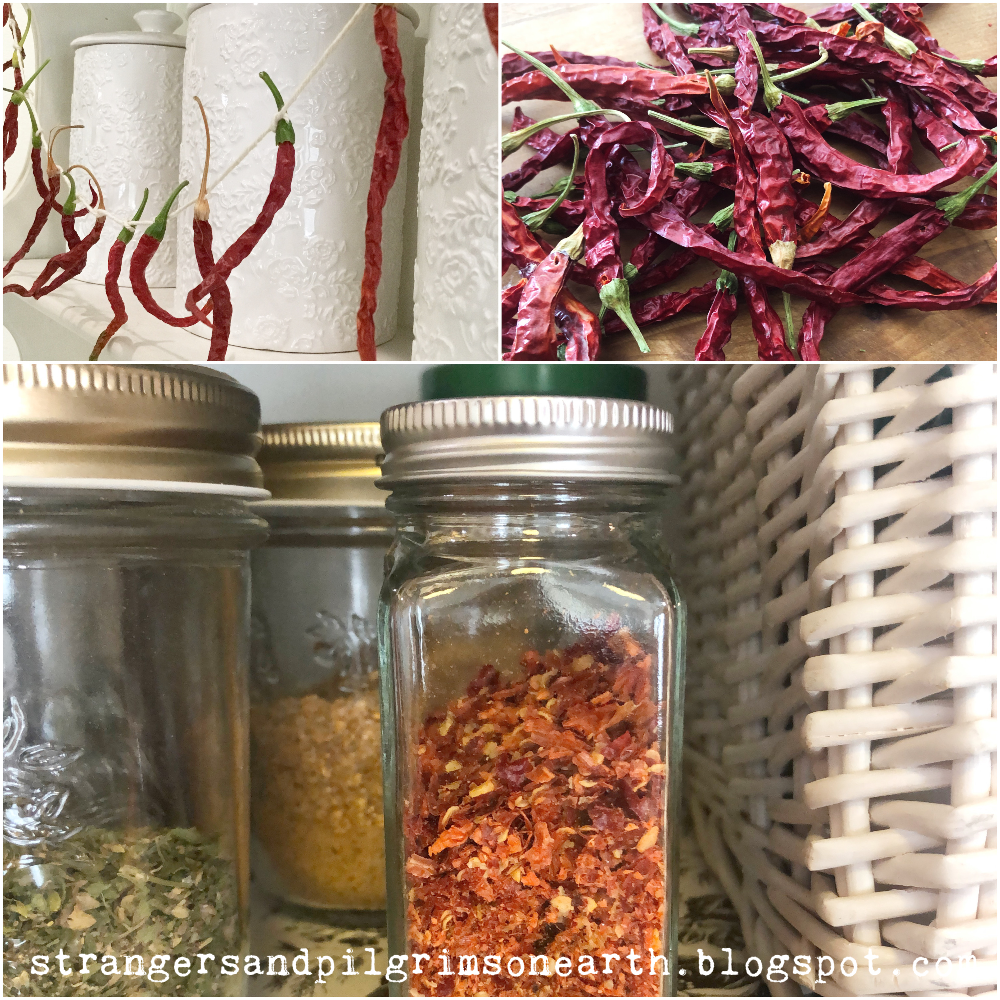
I ran out of red pepper flakes and was excited when I remembered I had put some dried chilies aside last summer. They were a glorious garland for awhile and now they will be a glorious addition to my spice cabinet. Storing them “whole” until you need them keeps them fresher longer. I just placed the dried (de-stemmed) chilis in my blender, let it go for a few seconds and poured the ground up pieces into a recycled spice container. It is quite satisfying to produce something from scratch for even the smallest jar in the pantry.

“There is nothing wrong with God's plan that man should earn his bread by the sweat of his brow.” 

“I wish to preach, not the doctrine of ignoble ease,
but the doctrine of the strenuous life."
~Theodore Roosevelt

Will you hear a quote like this from modern day man? The feeling one gets from today's society is that work is to be scorned. It is something we ought to avoid. We are taught instead to embrace a lifestyle of as much ease as possible. But in doing so, we are liable to lose the skills our ancestors used and needed to survive. 

As a believer, I don’t necessarily have fear for the future, but I do fear becoming “soft” for it. 

While I am no longer in a dire position to NEED to preserve our own food, I make it a point to as a discipline, an exercise in resourcefulness (amongst other reasons) and a way to beat inflation.

While I’m too frugal to actually purchase things to “put up”, I do go out of my way to preserve in various ways what is freely available to me. As my friend Kelsey recently said, “to use the whole buffalo”!

It may mean preserving only 2-3 days in a month, but it keeps me in enough “shape” to provide for my family the old fashioned way, to maintain a spirit of ingenuity with my resources and to keep me from getting (my worst fear) LAZY in this world of convenience. The obvious blessing is the continual building up of our provisions.

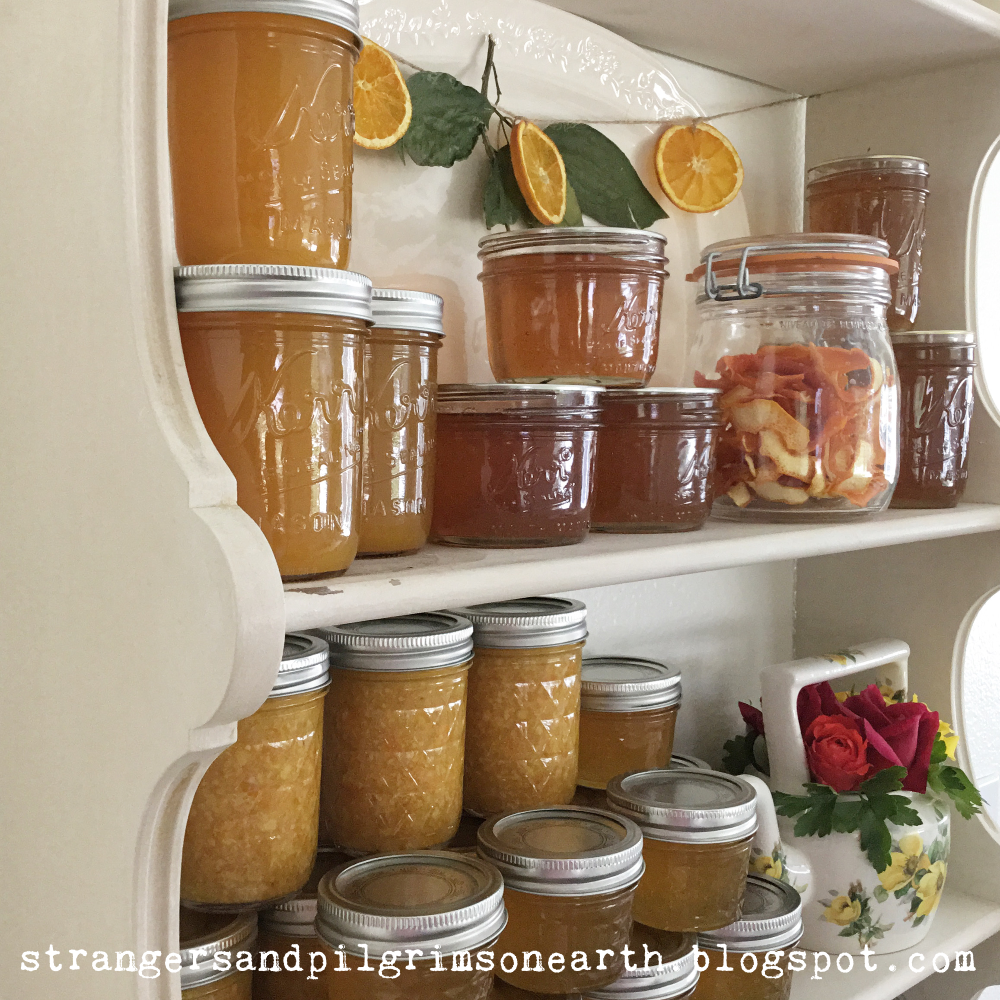
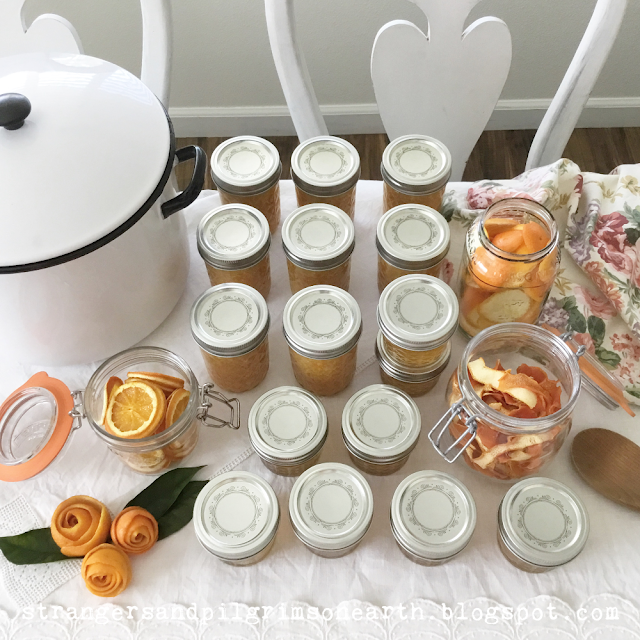
Produced for our home from a basket of organic, homegrown oranges:

- 8 quarter-pint jars of orange gem jelly

- 8 half-pint jars of macerated marmalade (this was an experiment and a failure at that)

 - 1 dehydrator tray dried orange slices (to be used in tea blends, infusing large jars of sun tea, potpourri, garnish and my newest idea of placing under roasting poultry to impart flavor)

- 3 dehydrator trays dried zest (which I removed from the oranges before making the jelly - for medicinals, cooking, baking, DIY products, etc.)

- jar of orange peel ends for the freezer (when I save enough I will make pectin with them) The ends can also be used to make many other things - visit my ebook for 100+ ways to use fruit scraps.

- a few quart jars of orange peel vinegar for making cleaning products.

- 3 orange roses (for fun!)

All in a days work.

"He becometh poor that dealeth with a slack hand:
but the hand of the diligent maketh rich."
~ Proverbs 10:4


A basket of additional homegrown oranges have been transformed into shelf stable jars of “orange syrup”. Just add some sparkling water and a handful of ice for a tasty spring and summer beverage.


To some, this is simply six quart jars of canned beets.

To others, it is more.

It is preparation of soil, it is watching the weather, observing the seasons. It is planting, thinning, watering and ultimately harvesting. It is washing, boiling, peeling and slicing. It is preparing hot jars and proper timing, weight and pressure. It is understanding the process of food and the importance of it. It was a days worth of work and yet it was a months worth of work. It is hard, time consuming and yet despite all this, very rewarding.

The slow system of proverbial preparedness is beautiful. It is not about panic but prudence. It is about capturing every little thing you grow and preserving each thing you are able for your household, however humble. It is the patient way one slowly adds to their provisions.

It was the way of our ancestors and it doesn’t hurt to bring it alive, whenever possible, into our own homes today.

The old ways may prove useful one day…

“The simple believeth every word:
but the prudent man looketh well to his going.”
~ Proverbs 14:15

"Simple industry and thrift will go far toward making any person of ordinary working faculty comparatively independent in his means. Almost every working man may be so, provided he will carefully husband his resources and watch the little outlets of useless expenditure."
~ The Royal Path of Life, 1882

“Say to the righteous that it shall be well with them,
For they shall eat the fruit of their doings.”
~ Isaiah 3:10


Cabbage and carrot processing day and the work of a homemaker’s hands…

Our harvests were modest but I was able to prepare a substantial amount of food for the upcoming weeks and to put some aside in our freezer for future meals.

Here is what our basket of cabbages and carrots yielded:

- 18 quarts of cabbage and carrot vegetable soup (I froze 14 quarts)

- 18 sautéed cabbage and carrot (with ground beef) pastry pockets 

- 4 quarts pickled cabbage slaw (this will last a few weeks in the fridge and will be used as a side dish with meat or as a condiment atop tacos, burritos, wraps, etc.)

- confetti cabbage salad (not shown in picture as I forgot to include it 🙈 but the recipe is shared here)

- One leftover quart of sautéed cabbage, carrot and ground beef filling from my “pockets” (to be used for a future dinner over orzo)

- one bag of carrots, kept raw for this month’s meals

Alternative caption:

In answer to two questions… how am I able to be a full-time homemaker & what do you do all day???

“Nobody gets on in the world who is half-hearted. If a man wants money he must hunt for it morning, noon, and night. If a man longs for knowledge he cannot take a book and ladle it into his brain with a spoon: he must read and study if he is to be a scholar. If a man desires to rise in such an age as this, he cannot do it without stern labor. Great discoverers, eminent artists, and powerful orators have all been men of hard work.”
~ Charles Spurgeon 

And if a woman desires with all her heart to be a full-time homemaker, despite monetary challenges, she must expect to do some work in the house. It may not be the kind that gets a paycheck but it’s certainly the kind that safeguards one. It’s definitely not a stereotypical BonBons and soap opera kind of life (nor should it be for a striving believer) but it is a good, noble and honorable one.

And with His help, it is also a blessed one…

“let the beauty of the Lord our God be upon us,
And establish the work of our hands for us;
Yes, establish the work of our hands.”
~ Psalm 90:17

Just some additional “food” for thought.


I also harvested many dandelions this spring and turned them into jelly, medicinals, vinegars, teas, salves (which I'll share soon) and bath products! It was so much fun to create from free resources.


“When you keep house, you use your head, your heart, and your hands together to create a home... Housekeeping is an art: it combines intuition and physical skill to create comfort, health, beauty, order, and safety. It is also a science, a body of knowledge that helps us seek those goals and values wisely, efficiently, humanely. Such knowledge is drawn from practical experience, family traditions, the natural and social sciences, and many other stores of understanding and information."

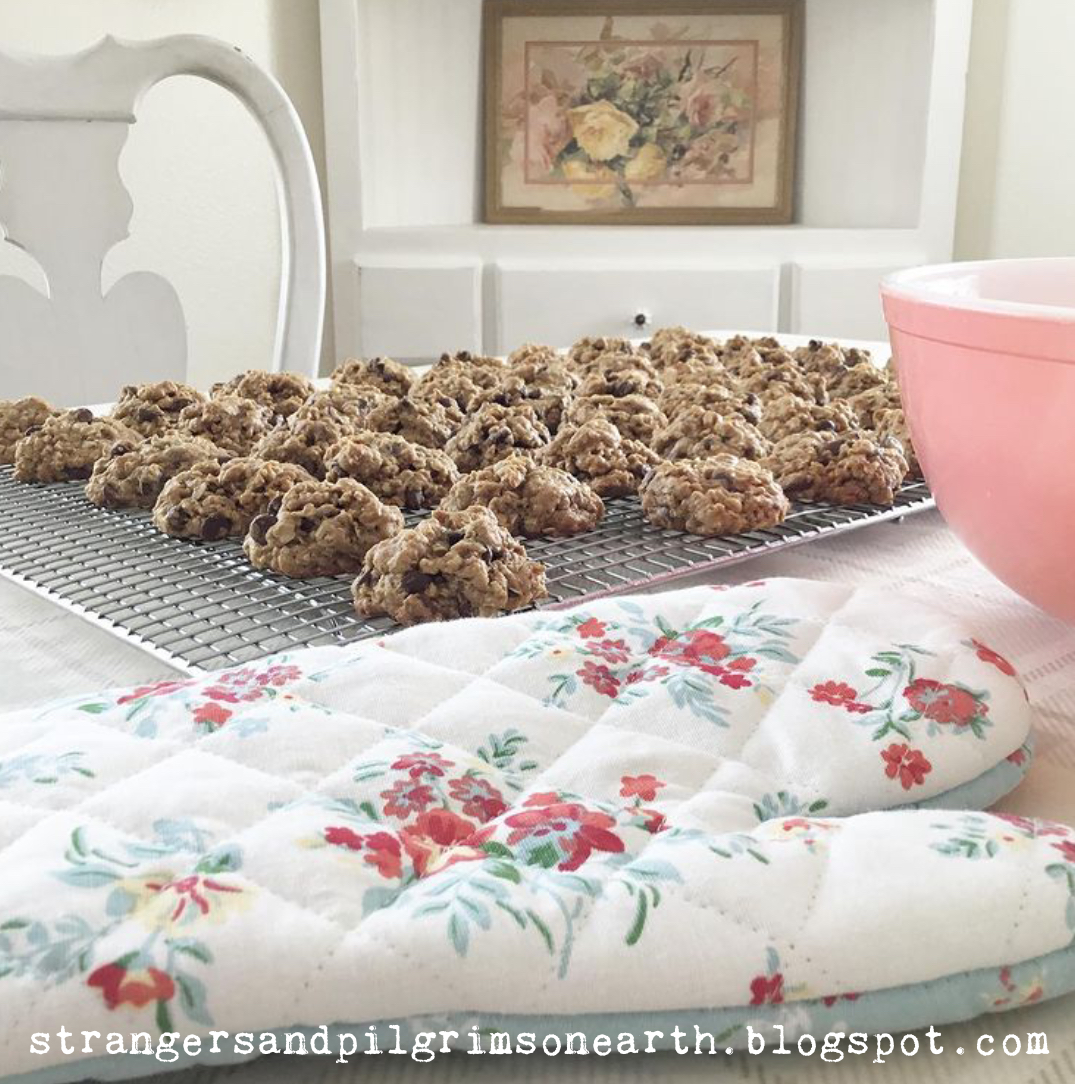
I’m “keeping house” today by using up the almost-expired nut butters and overripe bananas… because food waste is sad and productiveness is pretty! I’ve been taking a few moments to maintain our pantry and see what food needs attention. 

As quality nut butters are quite expensive, it pains me to throw them out. However, I have a few healthy recipes which utilize the nut butters as batter (and one of which uses overripe bananas with it!). Having such recipes on hand is a beautiful tool for the homemaker. I actually collect “use it up” recipes as they make for a quick save of our precious resources! You can make as many batches as necessary to use up the remaining butters by placing any excess in the freezer for safekeeping.

I have already shared this grain-free muffin recipe HERE and I’ll also share my grain-free cookie recipe soon! These make for a filling and nutritious snack. 

A part of a homemaker’s job is to make sure everything in her home is being used to its best capacity (including food storage). Taking a few minutes every few months to check your inventory is a worthy pursuit.

“She watches over the ways of her household,
And does not eat the bread of idleness.”
~ Proverbs 31:27


I also spent some time detailing the dining room.

With spring’s gentle arrival, I’ve been doing more home “maintenancing” (a mix of organization and some “light” deep cleaning).

Here was my dining room to-do list which I accomplished:

- Polish entire china closet from top to bottom✔️ 

- Remove everything in china closet, wipe interior down & reorganize (details shared below on this project for it turned into another project!) ✔️

- Polish dining room table & chairs ✔️

- Wipe down “surplus” pantry and reorganize contents (I have a corner cupboard in our dining room which discreetly houses our pantry reserves) ✔️ 

- Wipe baseboards ✔️

- Clean ceiling fan ✔️ 

- Clean blinds ✔️ 

A part of this room organization included two “new” purchases (which is a big deal in these parts). I always put aside any monetary gifts and slowly use them for pretty but practical things that add a special element to my home (items I wouldn’t normally buy with the general household funds).

For instance, last year’s gift was transformed into luxuriously cream-colored velvet hangers. The slim style is functional (as they take up less space in my small closet) and the uniformity brings pleasure to my order-loving heart.


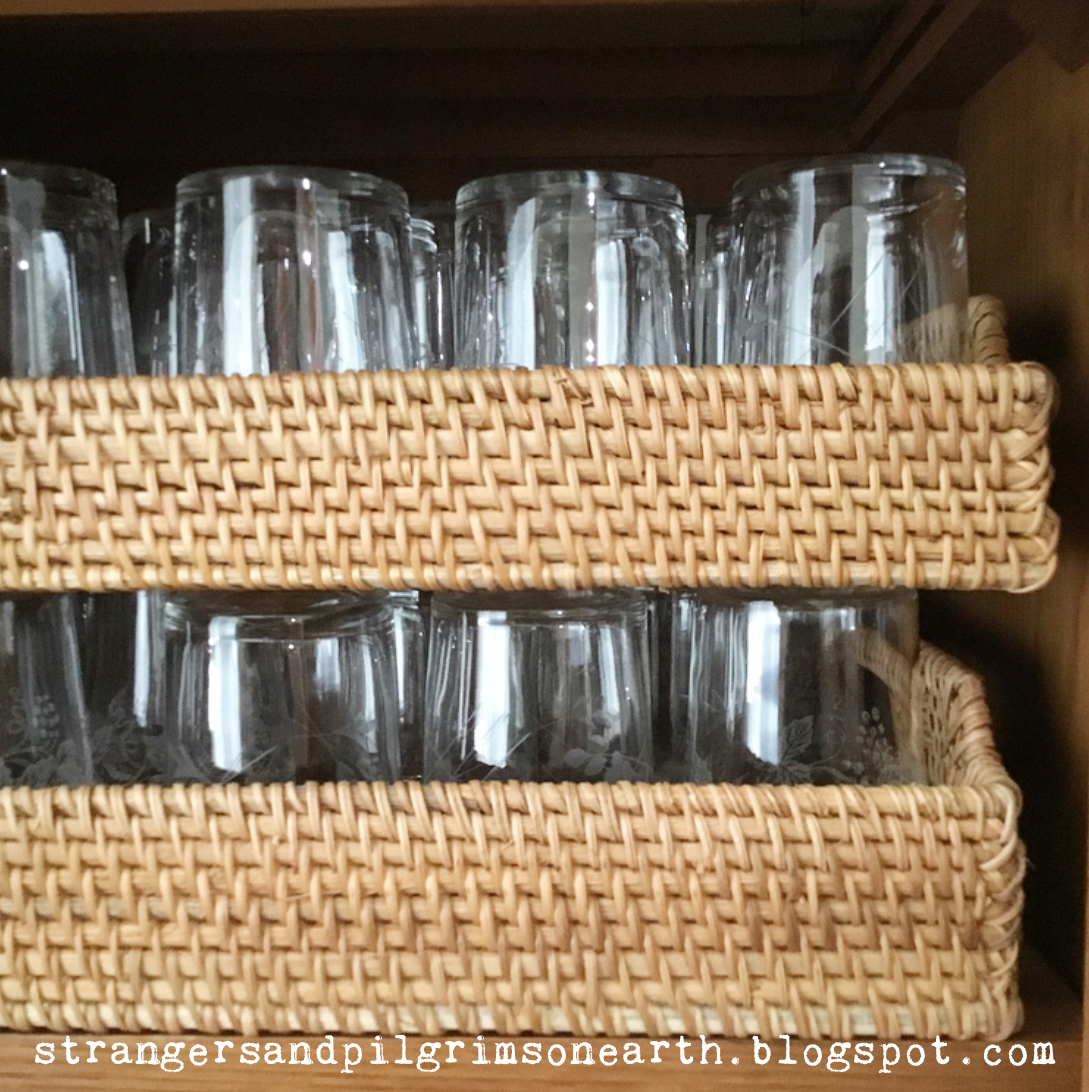
This year, as I surveyed the dining room situation, I noticed two areas which were in need of attention; my special silverware which were strewn willy-nilly all over the drawer and my tea glasses stacked dangerously on top of one another. Hence, this season’s special investment was a woven cutlery tray and two rattan basket-trays (pictured above) which I’m placing my tea-glasses in (for convenient storing and easy serving). I love how both purchases remedied the situation in a beautiful yet functional way.

And of course, no spring cleaning of a room is complete without a handpicked bouquet to symbolize a finished job and “the genuine pleasure that comes from doing something well.” ~ Margaret Kim Peterson

I share a printable “home maintenance checklist” should you like to try out this Victorian system suggested by the Beecher sisters in the 1800’s. 


My “Butler’s Pantry” was the project created from my detailing of the dining room:

“A butler's pantry or serving pantry is a utility room in a large house, primarily used to store serving items, rather than food. Traditionally, a butler's pantry was used for cleaning, counting, and storage of silver; European butlers often slept in the pantry, as their job was to keep the silver under lock and key.”
~ Wikipedia 

While my home certainly isn’t sizable nor do we keep a butler (as I’m sure many of you do 😉), I’ve always loved the idea of a butler’s pantry to store my little curated collection of thrift store dishes and such. Since this is completely out of the picture for me, I decided to set the stage of my China closet for such a purpose…

To make it utilitarian rather than decorative inside.

I love making little zones in my home and love that this one is centered around hospitality!


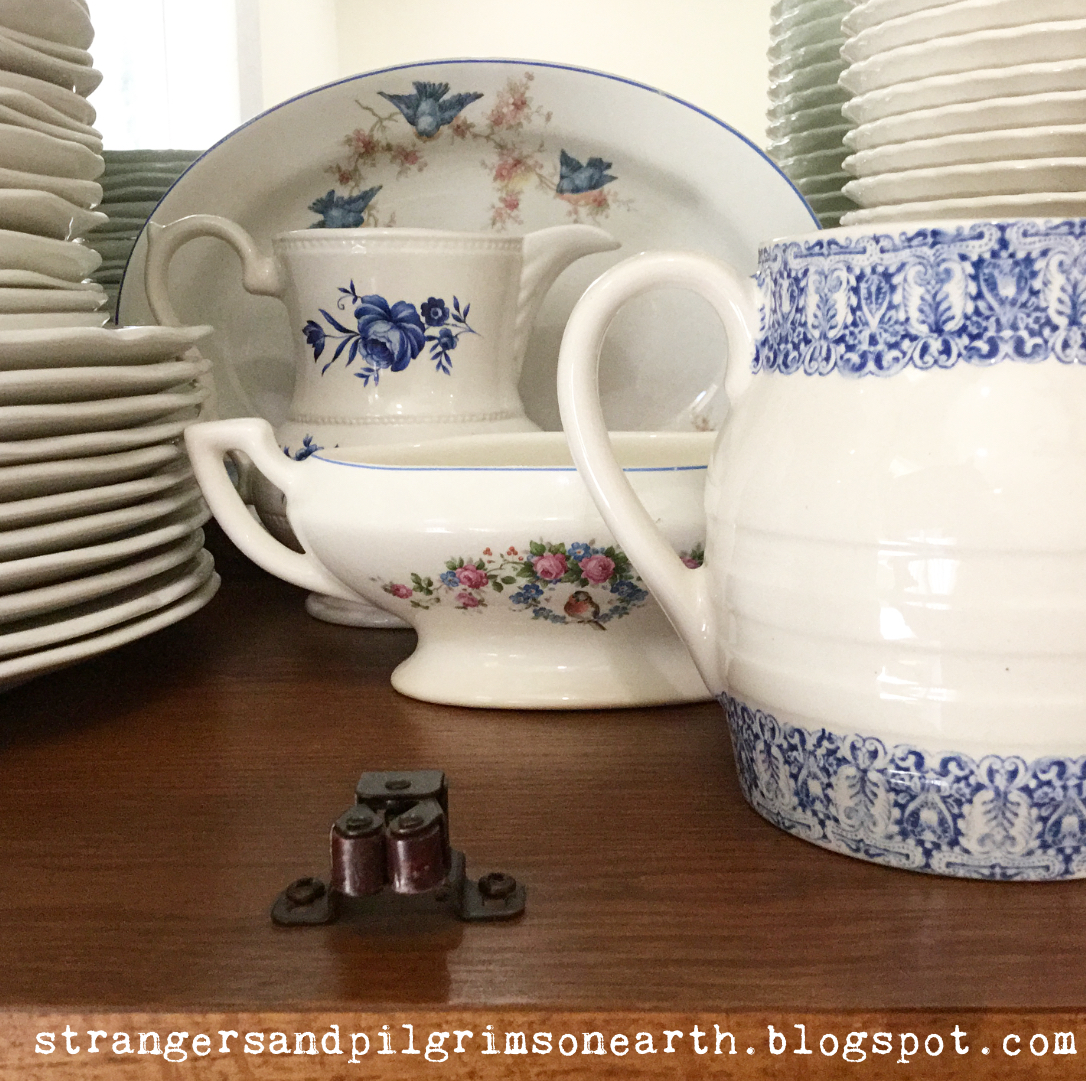
I piled all my plates together in proper order. I color coordinated my dishes so that when I want to set a blue and white table, it’s conveniently in one section. I placed my autumn and winter dishes together and so forth.


Underneath the hutch area, I have stored my serving dishes, tea kettles, etc., while the drawers hold my tablecloths and special silverware.


Everything that I need to host something more special for my family and/or guests are all carefully arranged for beautiful usefulness.

I love my little “butler’s” pantry! I think every home can have one provided space is available. I see outdated China closets in second hand stores for well under $100 (it seems everyone is getting rid of this traditional piece of furniture 😞). With a coat of paint, it can match your decor in minutes if the wood finish isn’t to your liking.

You can’t beat the quality storage (most are made of real wood which makes it quite a bargain!) and you certainly can’t beat the lovely abundance of organizational space it provides. 

It’s an old fashioned piece of furniture which can be used in a new, updated and “luxurious” kind of way.

“Making do” is a beautiful & satisfying pastime of the old-fashioned homemaker.

“Because when you are imagining,
you might as well imagine something worthwhile.” 
~ L. M.Montgomery, Anne Of Green Gables


Garden laboratory (our homemade calcium supplement)…

In our household, my husband is the green thumb gardener while I’m the crazy kitchen chemist. With just enough dangerous know-how, I can preserve most of the harvest into shelf stable food. However, this spring the tables have turned and I’ve begun preparing food for our harvests! 

We already compost our extra food scraps, leaves and paper. We save our wood ash and we dry chicken manure for use as fertilizer. This year we are adding this homemade calcium supplement to our list. One of the biggest reasons for preparing this is to prevent blossom-end rot with our tomato and pepper crops. This upsetting event occurs when there is a lack of calcium in the soil. Since eggshells are 95% calcium carbonate, we have a simple and frugal solution!

The concept is to keep as much industry as is possible alive in the home and to remove a constant need for commercially made products. Plus, the example of resourcefulness and productiveness for our children has its own special rewards.

It’s quite easy to make...

Here is my simple system:

Keep basket of eggs near stove. Keep gallon jar near basket of eggs. As we use our eggs, we drop the shells in the jar. When the jar is full, I dump them in a shallow wash basin outside to dry in the sun. 

Meanwhile, I place a fresh gallon jar in the kitchen and begin filling it all over again. 

Once the second jar is full, I bring in the sun-dried shells and blend them until finely powdered. I store the end result in a labeled mason jar until we are ready to use it.

Then, I dump the next batch of eggshells into the same basin and let those begin to dry… and on it goes!

A simple way to reduce, reuse and recycle for the kitchen garden.

Are you trying anything new in the garden this year?


With that being said, what about you dear reader? What wholesome and lovely things have you been reading, watching and/or working on? As always, recommendations are much appreciated as hearing about your homemaking endeavors always inspires me!

Happily homemaking,
♡ JES

(Some of the links in this post are affiliate links which help support this blog. Thank you!)


“Housework, too, is essentially physical. Indeed, a complaint commonly lodged against housework is that it is “menial” — work for servants — in contrast to other, higher kinds of work that may not include getting one’s hands dirty. But if Jesus himself could take up a towel and wash other people’s feet, surely we, as Jesus’ adopted brothers and sisters, can find it in us to wash one another’s dirty clothes and dirty dishes and dirty floors. Active engagement with fundamentally physical practices like housekeeping can be a way of remembering that a properly human life is a life of service in and through the body. It was so for Jesus, and it is so for us.”
~Margaret Kim Peterson, Keeping House

“For even the Son of Man did not come to be served, but to serve,
and to give His life a ransom for many."
~ Mark 10:45

“For you, brethren, have been called to liberty;
only do not use liberty as an opportunity for the flesh,
but through love serve one another.”
~ Galatians 5:13

“But you, be strong and do not let your hands be weak,
for your work shall be rewarded!"
~ 2 Chronicles 15:7


Tuesday, April 26, 2022

$haring Our Frugal Kitchen Reusable Linen Laundry System


“Well, now there is a very excellent, necessary, and womanly accomplishment that my girl should not be without, for it is a help to rich and poor, and the comfort of families depends upon it. This fine talent is neglected nowadays and considered old-fashioned, which is a sad mistake and one that I don't mean to make in bringing up my girl. It should be part of every girl's education, and I know of a most accomplished lady who will teach you in the best and pleasantest manner."

"Oh, what is it?" cried Rose eagerly, charmed to be met in this helpful and cordial way.

"Housekeeping!"

"Is that an accomplsihment?" asked Rose, while her face fell, for she had indulged in all sorts of vague, delightful daydreams.”
~ Louisa May Alcott, Eight Cousins

Yes indeed, dear Rose, it is a delightful accomplishment! To run a home of your own using all the order and loveliness you can muster up is a fulfilling and nurturing existence. And even the daily rituals of kitchen-linen-keeping can become beautiful if we put our heart into it. For instance, I haven't purchased paper towels or napkins for our home in over 10 years. One reason I enjoy it is because I love the pretty fabrics I get to work with each day. It brings such delight! This has also been an economical blessing and I see the beauty in that! Because of my enthusiasm, I often get asked about the washing of kitchen linens and my laundry process in general.  I think that an efficient laundry system is what keeps this happening in our home and I'm happy to share some methods I have implemented along the way to make this possible.


There are two important factors that make it work for me.

One is having a decent inventory of linens (don't worry, this can be done very frugally!) and the second is having a designated kitchen laundry "outpost". Both of these concepts are key and I'll go into all the nitty-gritty details for all of you detail-loving homemakers out there who share the same interests in daily homemaking routines. There are more of us out there than we realize ;)


First off, to make this run smoothly, it helps to build up a generous supply of cloth napkins.

It works best with pretty ones since you won't mind washing and folding them! But of course, that it entirely my preference. But by having a nice surplus of napkins, you will eliminate the need to wash so frequently which gives you freedom to use real linens in your home. It will remove the stress that you haven't washed a fresh batch quick enough to keep up! It basically allows for more "grace" in your laundering routine. We don't have to worry about having enough table linens when there is plenty of stock to rotate. If you are going to start a system, I recommend having at least 3 - 4 sets to start with. A decent inventory is key to success! And this can be achieved simply and frugally in a manner of ways. 


Frugal ideas to build up your napkin supply:

1. Make your own.

You can achieve this by cutting down old sheets and/or tablecloths which don't fit any tables (or which never get used). You can use my No-Sew "Snip & Rip" process and have a set of 12 in less than 30 minutes! 


I like to make them to match each season and by doing this, it keeps it interesting for the homemaker. You get to see different patterns at different times which adds a bit of delight to the laundry pile. But of course, this is not necessary! I only began doing this when I realized how easy it was to fabricate a napkin with just a snip of the scissors. 


Of course, if you are handy with a sewing machine, you can purchase inexpensive sheets with pretty prints and sew them into napkins. Or, you can even thrift pretty linens and turn them into napkins.  I have found beautiful floral (Ralph Lauren) bedding for $1-2 at a second-hand store that I had such plans for (but to be honest, I ended up just snipping and ripping those too! Pictured above). Many people donate odd and end bedding and these would make fine table linens (just place thrifted fabric in the dryer on high heat for 20 minutes to sanitize them -- before putting in your washer -- and then launder the linens in hot water, followed with a nice strong vinegar rinse)! I received these instructions to sanitize linens from an exterminator (interesting but beneficial source, right?) and I so appreciate these handy tips!


2. Buy a set of cloth napkins each time you would normally buy a set of disposable napkins.

Every time you would usually buy the $20 dollar pack of paper towels, invest in a set of napkins instead. They are very affordable at discount stores (Marshall's, Ross, TJ Maxx, Home Goods) and completely inexpensive at thrifts stores. Continue to do this each time you would need to buy more napkins/paper towels and eventually you will have a good supply of inventory. The buying will eventually stop and the money saving will begin! It is much funner (and economical) to purchase a pretty set of napkins for the price of a warehouse bulk purchase of napkins. Every year I would splurge on an attractive set of 12 (which costs around $12-15) and they ended up paying for themselves in the next few months. Not only is your table more of a joy to set, the grocery bill is lowered and good stewardship is being practiced. 


3. Use what you have.

My guess is that you probably have a stash of napkins somewhere. Perhaps they were grandmothers or set aside for special holidays and so forth. Either case you have them and are not using them in any way. Perhaps it is time to bring them out, allow them to get used (even stained!) because what is the purpose of their existence if it isn't to be of service? Start using these sets and slowly add to your collection from the ways shared above. Then, when you have enough accumulated, you can safely remove these from the rotation should you want to preserve them for some reason.


Be practical:

Overall, when choosing fabrics or buying napkins, it is best to utilize dark or patterned napkins so that obvious staining won't be a hindrance in this routine (especially with younger children, more on this later). Even solid napkins can be a problem if you are concerned about stains (the busier the fabric, the more stain-camouflaged they will be).


Convenient Location is Key:

In order to make the napkins convenient to use, I found it helps if they are visible. This is also good for when you have guests. They will look around for a paper towel and napkin and when they see the basket, they realize this is what they should use. We now keep our napkins in a wicker basket on our table. In our other home, we kept them on the lowest shelf of our baker's rack. Either way, this makes for easy access when setting the table and is convenient when putting fresh linens away. Because I have so many, I also have a few baskets scattered in the kitchen dining area that are filled with my surplus of napkins. This is not only for convenience but it is also a pretty but practical decoration.

On ironing and wrinkles:

If I line dry our linens and clothespin them firmly, corner to corner, they dry nice and smooth. In the dryer, if you fold them immediately while hot, they fold up beautiful. There are a few thicker fabrics that crinkle at the corners which can be frustrating but the ones I make (no sew) with light cotton sheets launder well and fold wonderful! 


Additional linens to have on hand -

Reusable Paper Towels:

While napkins are obviously helpful for meals, the paper towel can be re-created into un-paper towels. Once again, one less thing to buy! I've been using these for years and love to make them in flannel "double-ply" fabrics as they are quite absorbable and durable. But, you can also just cut up old clothing, bedding, etc., into squares and use that instead. Some ladies purchase inexpensive towels at Dollar Stores and use these happily (and without labor) as paper towel replacements. To make this convenient, place your version of the un-paper towel in a basket somewhere in the kitchen that is readily available. Anytime there is a spill or kitchen mess, simply grab the un-paper towel to mop it all up!


You will find my un-paper towel tutorial HERE if you would like to sew your own. I have found some delightful floral flannel remnants at second-hand stores that I've turned into lovely un-paper towels for pennies. 


Of course, now that I have finished homeschooling, I have a bit more time so I have also made up some seasonal prints of un-paper towels for our kitchen. It's the little things dear homemaker!

Grease has also been brought up with concern in various conversations. When frying tacos, I have used my un-paper towels as absorbable napkins and will give them a light wash under the kitchen sink with dish soap before placing them to dry overnight (prior to adding to laundry pile). But I will be honest, my husband isn't so thrilled with this idea and he purchased one roll of paper towels purely to be used for absorbing grease (he placed them under the kitchen sink so they are not so easy to access). I have also just used parchment paper to line this type of food but I'll be honest, I don't deep fry too many things. This is an area that you will have to decide what works best for your household as there is no perfect answer (unless you have one?). 


Dishcloth DIY:

I also thought to share this little project as it fits into the general theme of the post. You can repurpose worn-out bath towels (or in this case a damaged and vintage, hole-filled terrycloth tablecloth) into cottage-style dish rags. Simple cut out squares of approximately 12" or so (I just used a washcloth as a pattern) of the undamaged areas of the chosen linens. You can either hem the entire cloth (if that is the case you may want to cut out a larger size) or use a bias tape and sew around the perimeter. I used leftover strips of different fabrics from my leftover sewing projects and created my own edging with them. It was fun to make a set of these dishcloths in various designs. Rick-rack edging would also be darling for this! I use the dishcloths (shared above) to wipe and clean our tabletops, countertops and stovetop (basically, the more sanitary cleaning while the un-paper towels deal with the dirty floor messes and spills).


Tablecloth Tips:

Some of us have tables that need covering before setting out meals and/or they like to keep a constant tablecloth on the table for decoration. This is the case for me. And since I don't want to wash a tablecloth for every meal I prepare, I have found some useful products for laundry convenience.


When we had younglings, we always used an oil-cloth tablecloth because of its ultra slick surface (shown above). These make it VERY easy to wipe up spills, protects the wood or painted surface on your table, lessens your laundry load while being pretty at the same time (you can find them in a variety of prints -- I always loved the vintage floral or checkered designs). You can find beautiful oilcloth patterns at your local fabric store and simply have it cut to size (with no sewing necessary). The best part is that these tablecloths don't require any laundering!

This fabric also makes for convenient coasters (tutorial here).


Please keep in mind, there is a difference between an "oilcloth" tablecloth and a "vinyl" tablecloth (which are often found at discount stores a-plenty). While the vinyl tablecloths (pictured above) are less expensive, they can be frustrating to maintain. Because of their flannel-backing, they can get slippery when wiping and are less sturdy than a traditional oilcloth tablecloth. Of course, either will do for the purpose of reducing laundry but I prefer the traditional oilcloth as it is much more durable and user-friendly. It is definitely worth the extra investment because the oilcloth can hold up for years with proper care and they wipe clean with ease (and don't have the frustrating "move everywhere" effect). But I won't pretend I haven't got lured into buying the vinyl when they have cute patterns!


Now that our family is older, I prefer using the "laminated cotton" tablecloths (pictured above). These too are wipeable and can be used all week long if maintained properly. I just wipe the crumbs off the table each evening and then spray any stains with my all-purpose cleaner and it is as good as new! The laminated cotton tablecloths appear more like a "normal" cotton cloth which is lovely (but they are dipped in some kind of laminate). However, they would be a bit harder to maintain with toddlers as the surface isn't as slick and would require "spot" cleaning (unlike oilcloth which wipes away in a swipe of the rag!). Also, the "laminated tablecloths" need to be laundered every week to keep them fresh while the oilcloth does not.


Sponge $avings and other Washing Sentiments:

Regarding the dish-washing system, I personally use a sponge (cut-in-half to extend the life of the sponge) to wash all my pots and pans. The sponges can be placed in the dishwasher to sterilize them as necessary (if you don't have a dishwasher, it can be washed in the washing machine with your normal kitchen linens). 

I use my dishcloths to wipe/clean our tabletops, countertops and stovetop. I end up changing out my dishcloth every day or so depending on the work it has done in a day. I don't use my dishcloths or kitchen sponges to wipe up spills on the floor, etc. (as that would contaminate it for the surface cleaning I do in the kitchen).

I use the un-paper towels for more of the "dirty work" in the kitchen.


The "Kitchen Linen Laundry Basket" is a Beautiful Tool:

And finally, the most important aspect of this system for me (besides the abundance of napkins) has been the "kitchen linen laundry basket" (aka the designated kitchen laundry "outpost"). I keep this hamper right near the kitchen so that as soon as we clear the table, the soiled linens get tossed inside. It is also the convenient place to throw in your dirty dish towels and kitchen rags (and tablecloths if you are using). Once this hamper is full, I know it is time to put in a load of wash! For our smaller household it is only necessary to wash once a week but larger households may have to wash twice a week. Children can be in charge of folding the linens as they are so easy and this makes it super simple for dear mother. It is important to note that no other laundry gets placed in this. You want to keep it kitchen oriented so that you have control of seeing when it is time to wash your table linens AND that you can easily place everything inside your washer without needing to sort through anything. Plus, you will be treating these linens a bit different in the washing machine which makes even more sense to keep them all together.

I have no issues with mold when I place damp kitchen towels inside since I wash these once a week and it is "airy" in a hamper. However, with dishcloths that are completely wet, I leave them overnight on the sink to dry a bit better before adding to the hamper. 

I have seen some darling hampers at thrift stores inexpensively. It kills me to not buy them all and bring them home! Perhaps you can rescue one for me for this little household project?!


Washing the Linens:

Doing a large load using hot water (which I personally like to use for table linens) costs approximately $1 per load (according to some quick Google searches) which still makes this a very cost efficient system. Because there is raw meat involved in kitchen work and a plethora of spices, oils and smears (I'll stop here), I like to sanitize my kitchen linens a bit more than my normal wash loads. Once every two months, once the laundry agitates and the soap is in, I'll add some baking soda, or borax (or Oxy-Clean if it really needs it) and let the wash agitate a minute more and then stop the washer and let the mixture soak overnight. In the morning, I will press start and finish the wash cycle.

On a daily basis, I will use my lemon infused vinegar as a fabric softener to freshen things up. When I run out of my infused vinegar, I will add a scoop of baking soda to the loads for extra cleaning power. I will be honest, I do not individually treat each napkin for stains. I NEVER DO (and my napkins always "appear clean"). That would make this concept too burdensome! I strategically choose fabrics that are printed enough that a little stain here or there won't harm the overall appearance. A set of plain white napkins, for instance, would not be used on my daily dinner table (that is something I would reserve for special events). Once again, a dark or patterned napkin is the ideal choice. 


EXTRA FRUGAL SUGGESTIONS --

There are years we had to live quite lean and I had to utilize some of these concepts below. Perhaps you are at this point in your life? If so, these ideas may be helpful for you. Any sacrifice you make to stay home is worth it dear ladies!


Ideas to Reduce Wash Loads:

If constant washing of linens is a concern, consider utilizing the Victorian Era technique of using individual napkin rings. Each person should have something to distinguish theirs from all the rest (perhaps a different color per person or another form of identification) so that each person can reuse their own napkin for all the meals in a day (the Victorians would make it stretch until wash day attempting to change them at least 2 - 3 times per week). Though modern day napkin rings are more for show, you can see there was once a purpose beyond a beautiful display and that was the beauty of less laundry!

Another idea I learned from this frugal living book was to invert your "used" napkin for the next meal so that you have a clean surface to start with. If you are really thrifty, you can get away with folding one way, then the other way for the next meal and then finally place the napkin inside out. I personally wouldn't recommend going that far if you are serving sticky meals such as ribs or any other greasy food which would be less than desirable to reuse (but I definitely have done the inside out method to stretch it one more meal when times where tight!).


Ways to Save Even More Money:

For extra savings, consider hanging out your lovely linens to dry instead of using a dryer. They look so beautiful flying on the line and there are many benefits to using a clothesline. Just don't leave them out all day when very hot and sunny because the sun does bleach (which is good to some extent because it disinfects your linens)! But it may also fade your linens if you keep them out all day.


You can also make your own stain treatment spray, fabric softener and laundry detergent to save money.


And lastly dear reader, my constant reminder here on this little blog... It is not about whether or not you use cloth napkins or in the end, if you use disposable paper napkins! The most important part is that you are preparing a table for your loved ones each night, not only nourishing them with food, but with precious prayers and family fellowship. The "breaking of bread" together in the home was a significant part of the Lord's ministry and should be just as important in the ministry to your family as "keeper of the home".

"And he took bread, and gave thanks, and brake it, and gave unto them, saying,
This is my body which is given for you: this do in remembrance of me."
~ Luke 22:19

And they devoted themselves to the apostles' teaching and the fellowship,
to the breaking of bread and the prayers."
~ Acts 2:42 (ESV)

"Wisdom has built her house...
she has also furnished her table...."
~ Excerpts from Proverbs 9:1-2


Have a beautiful day and please feel free to share your frugal, kitchen linen laundry system in the comments! It is fun to learn from one another and these kinds of homemaking tips are always appreciated!