Showing posts with label School Subject: Fine Arts. Show all posts

Monday, January 20, 2014

About Globes ~ A Geography Inspired Picture Study

The Geography Lesson – Monsieur Gaudry And His Daughter by Louis-Leopold Boilly

Here are some picture studies that you can do with your children to give them a taste of geography and art at the same time. This is such a fun and harmless way to teach these subjects! Perhaps you would like to choose one painting to view and one geography concept per week to study?

Below are some questions and activities for the children to coordinate with each piece that share basic information about globes.

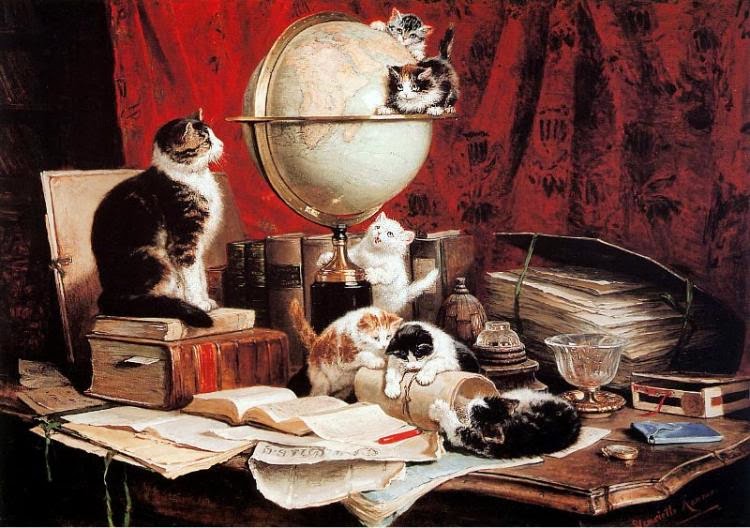
On Top of the World by Henriette Ronner-Knip

  • Share the name of the painting and artist and ask the following questions:
  • Do you like this artwork? What are your thoughts on it?
  • How many kittens can you find in the painting above?
  • Do you think the owner of these items will be pleased when they see this mischief?
  • Have you ever spent any time analyzing a globe?
  • Did you realize it is more accurate than a map because the shape of the globe mimics the shape of the earth? How can you flatten something round (like a map) and expect it to be perfect when placed on a flat surface? (Try this with an orange for a fun experiment.)
  • Did you know that the earth is really 30 to 40 million times bigger than a globe?
  • Can you point out where you live on the globe?
Portrait of Doctor Trioson Giving his Son a Geography Lesson by Anne Louis Girodet

  • Share the name of the painting and artist and ask the following questions:
  • Do you like this artwork? What are your thoughts on it?
  • Do you know what Geography is? According to Merriam-Webster Dictionary, it is "a science that deals with the description, distribution, and interaction of the diverse physical, biological, and cultural features of the earth's surface." What does your dictionary say?
  • That means geography is more than maps and globes, it is about the kind of animals that live in certain areas, the culture of the people and knowing what kind of food they eat! Yes, that would be considered geography too! Famous places (such as the Grand Canyon) would be a part of geography as well. What geographical areas by your home do you enjoy visiting?
Geographer by Jan Vermeer

  • Share the name of the painting and artist and ask the following questions:
  •  Do you like this artwork? What are your thoughts on it?
  • The man in the picture above is a geographer. The artist of this painting has a love for globes and maps since about 6 of his paintings feature one or the other in the background. Next time you view a Vermeer painting, see if you can find one. Here are a few to visit: Soldier and the Laughing Girl, Woman in Blue Reading a Letter, Young Woman with a Water Pitcher and The Astronomer.
  • Do you know what a geographer is? (A geographer is a scientist whose area of study is geography, the study of Earth's physical environment and human habitat.) Christopher Columbus was one. Do you know of any others?
  • Print out a picture of a globe on a piece of paper and have the children label in "north, south, east and west". Younger children can just point it out on the globe with your help.
  • Did you know that the line going across the the globe (east to west) is called the "equator" and is just an imaginary line that divides the earth in half? Older children can label the "equator" on their globe print out.
Where Papa Is by Davidson Knowles

  • Share the name of the painting and artist and ask the following questions:
  • Do you like this artwork? What are your thoughts on it?
  • Did you know that the northern hemisphere is the top part (north) of the globe while the southern hemisphere is the bottom (south) part? Which hemisphere do you live on? Older children can label both hemispheres on their globe print out while the younger ones may try and point them out.
  • Did you know there is another line called the "prime meridian" which divides the earth another way (going north and south)? It runs up and down starting at the North Pole and ending at the South Pole. Can you find the North Pole? Can you find the South Pole? Older children may label these on their globe print out while the younger ones can point them out.
  • This "Prime Meridian" is technically dividing the globe into two halves which are called the eastern hemisphere and the western hemisphere. Which side do you live on? You can also have the older children label the eastern and western hemispheres on their globe while the younger children may just point them out.
Inquisitive Boy by Eduard Swoboda

  • Share the name of the painting and artist and ask the following questions:
  • Do you like this artwork? What are your thoughts on it?
  • Do you think the boy above likes to learn?
  • Do you think that the globe in the picture is for him to find all the unusual places he reads about? I do!
  • Did you know that the globe is divided into more sections using imaginary lines? These lines are called latitude and longitude.
  • The latitude lines are horizontal meaning they are the lines that go across the globe (east to west). Can you find these man made lines on your globe? Label them on your globe print out.
  • The longitude lines are vertical lines that go up and down the globe (north to south). Can you find these man made lines on your globe? Label them on your globe print out.
  • Looking at both sets of lines on the globe, you will see that the checkerboard type look is called the "global grid". This grid helps us to locate places on the globe.
The Geography Lesson by Pietro Longhi

Challenge for older students:
  • Older students can be given some coordinates and see if they can find the places you designated for them.
  • Now, have them choose three places on the globe that they would love to visit and see if they can create the coordinates for you!


This post may be shared with some or all of the following link-ups: Monthly Geography Hop, Modest Mom Monday's, Homestead Barn Hop, Teach Me Tuesday, Raising Homemakers, Make Bake Create, Wise Woman Link Up, Christian Homemaking, Wildcrafting Wednesday, Frugal Days, Sustainable Ways, Homemaking Wednesdays, Homemaking Thursdays, From the Farm Blog Hop, Farmgirl Friday, Clever Chicks Blog Hop and Deep Roots at Home. Thank you lovely ladies for hosting these. 


Wednesday, November 20, 2013

What is a Picture Study? ~ Charlotte Mason Series


“We cannot measure the influence that one or another artists has upon the child’s sense of beauty, upon his power of seeing, as in a picture, then common sights of life; he is enriched more than we know in having really looked at a single picture.”
~ Charlotte Mason, Excerpt from Home Education

"Picture study" was one of the first ideas that inspired me about home education. It seemed so elegant and lovely to share beautiful artwork with your children, treating them to a masterpiece feast by the greatest artists of all time. To view pictures for the pleasure of the little child with no harsh memorization lessons, but only pure delight.

Have you considered sharing a few moments with the masters? They require little work from the teacher but the result is a sweet appreciation for the finer things in life. Not the fast and the furious that is plaguing the billboards today, but the slow and deliberate, classical creations of the human hand.

Mother and Child in a Picture Gallery by George Goodwin Kilburne

"We recognise that the power of appreciating art and of producing to some extent an interpretation of what one sees is as universal as intelligence, imagination, nay, speech, the power of producing words. But there must be knowledge and, in the first place, not the technical knowledge of how to produce, but some reverent knowledge of what has been produced; that is, children should learn pictures, line by line, group by group, by reading, not books, but pictures themselves."
~ Charlotte Mason, The Philosophy of Education


A "picture study" can be as simple as taping a masterpiece on the refrigerator every week and letting your children study, stare and share as they eat their meals. (A dollar store calendar featuring famous art is perfect for this!)

Or, a notebook can be assembled of all your chosen paintings along with a brief artist biography, the child's picture reviews and any other pertinent information you wish to document.

The general object is to expose your children to fine artwork in order to promote an appreciation and interest in the art itself. For once the flame has been lit, the love of learning will continue to grow.


"It will be noticed that the work done on these pictures is done by the children themselves. There is no talk about schools of painting, little about style; consideration of these matters comes in later life, but the first and most important thing is to know the pictures themselves. As in a worthy book we leave the author to tell his own tale, so do we trust a picture to tell its tale through the medium the artist gave it."

The Ancestors by George Goodwin Kilburne

Where to start?

"The child is given his first reproduction. He looks at it, and you let him talk about the picture. You don't lecture about schools of painting or style. The child is allowed direct and fresh access to the picture itself. At first, he may focus on little…

Next time, the skill will become sharper, the child more observant. He will regard the pictures as friends."
~ Susan Schaeffer Macaulay, For the Children's Sake


At the British Museum by George Goodwin Kilburne
"Children whose minds and spirits are nourished with these paintings will, in turn, look at the world around them with new eyes. They will comment on the quality of dappled light under the trees, or note that the storm clouds remind them of a Rembrandt landscape. It is a wealth that will remain with them for life."
~ Susan Schaeffer Macaulay, For the Children's Sake


Some other practical ways to implement picture study into your homeschool:
  • After studying the artwork, take turns pointing out all the details in the painting and sharing how each person feel's towards the picture. You may be surprised at how strong of an opinion they have on art!
  • Flip the print over and see what details the children can remember without looking at it.
  • Once the artwork has been discussed, turn the print over and see if your students can recreate it on a blank piece of paper. This will encourage them to dig into the details when they study the picture!
  • If the print has a historical event attached to it or a scene from the Scriptures, read together some pertaining information to make the painting come alive.
  • As the student gets older, you may want to prepare a portfolio of the art you have studied. We did this when we had a child old enough to write which included their treasured art reviews. 
  • Read a short biography about the artist of the painting. Share other artwork by the artist and compare them. Do they notice anything in common? Does the artist always paint people, landscapes or historical events? Study more paintings from the same artist until you feel like you "know" them and then move on to another.
  • We also like to do themed picture studies where something is being learned which pertains to the painting. You will find our versions here: Bible in Art Picture Study Part 1: Van Gogh and Bible in Art Picture Study Part 2: Rembrandt.
  • Include picture study in your unit studies. When we studied Noah's ark, we studied famous ark paintings in history. When we studied apples in autumn, we studied the famous apple paintings by Cezanne. 
  • Purchase curriculums that include picture study in the workbooks such as the Language Lessons series from Queen Homeschool (affiliate link).
  • Be creative, there is no right way to enjoy art!  All it takes is a few minutes each week...
Young Girl Reading by George Goodwin Kilburne
"Make it (picture study) a happy warm time,
just like when you enjoy a story together."
~ Susan Schaeffer Macaulay, For the Children's Sake


Monday, March 19, 2012

Bible Primer in Picture Study Series: Part Two Rembrandt


This marks the second segment of my "Bible in Art Series of Studies" for children (first segment here). These are meant to incorporate basic knowledge of the Scriptures along with a taste of art through picture study. Try one of these lessons a week with your children and watch as they gently teach them a variety of information in just a few minutes or if you aren't a homeschooler, you can see if you can glean anything yourself! Who says we stop learning once we leave "school"?

Rembrandt's Mother Reading the Bible by Rembrandt

Have your children study the painting above by Rembrandt and discuss the following with them:
  • Have you ever heard of Rembrandt? He painted the picture above of his mother reading the Bible.
  • He is a Dutch painter. Can you find Dutch on the map? (No, we call the country that the Dutch people reside in, Holland.) Can you find Holland on the map or globe?
  • Rembrandt is considered one of the greatest painters of all time. He spent a lot of time with his family and included them in much of his art. He also liked to dress up and paint fun pictures. Do you enjoy doing that as well?
  • What colors do you notice in the painting above?
  • Open up your Bible, does it look similar to the one his mother is reading?
  • Do you think the woman in the picture will ever learn all there is to know in the Scriptures?
  • Did you know that the first five books of the Bible are referred to as the "Law" or "Pentateuch"? Pentateuch comes from the Greek term meaning "five volume book". The Jewish people call this the "Torah" which simply means "instruction".
  • Can you locate these five books in your Bible and name them to your mother?

Memorize the following Scripture and discuss the meaning together:

"Thy word have I hid in mine heart,
that I might not sin against thee."
~ Psalm 119:11

Guessing Game:

Rembrandt painted many pictures of Biblical scenes. Can you guess the Bible story that corresponds to the paintings below? Be sure to look at all the details like a detective. I will place the answers at the bottom of this post:


    Continue with your discussion using the questions below:
    • Now that you have seen some of the artwork of Rembrandt, do you like his paintings?
    • Why or why not?
    • Ask your children if there is a difference between the paintings of Vincent Van Gogh and Rembrandt (whom were both Dutch). What makes them different? Do they both paint with the same moods? Do they use the same colors and style? Do they prefer one artist over the other? Why or why not?

    Instruction from Scripture ~ A Poem for Children by Isaac Watts

    How shall the young secure their hearts, 
    And guard their lives from sin?
    Thy word the choicest rules imparts 
    To keep the conscience clean. 


    When once it enters to the mind, 
    It spreads such light abroad, 
    The meanest souls instruction find, 

    And raise their thoughts to God. 


    'Tis like the sun, a heav'nly light,
    That guides us all the day; 

    And through the dangers of the night, 

    A lamp to lead our way.

    The men that keep thy law with care,
    And meditate thy word, 
    Grow wiser than their teachers are, 
    And better know the Lord.

    Thy precepts make me truly wise:
    I hate the sinner's road; 
    I hate my own vain thoughts that rise, 
    But love thy law, my God.

    The starry heavens thy rule obey, 
    The earth maintains her place; 
    And these thy servants night and day 
    Thy skill and power express.

    But still thy law and gospel, Lord, 
    Have lessons more divine; 
    Not earth stands firmer than thy word, 
    Nor stars so nobly shine.

    Thy word is everlasting truth,
    How pure is every page! 
    That holy book shall guide our youth, 
    And well support our age. 


    Final Review Activities:
    • You can finish up this study by reading the poem above by Isaac Watts to your dear students.
    • Review the information above through a few minutes of oral quizzes.
    • Have your children repeat their memory verse.
    • It might be fun to show a variety of paintings to the children and see if they can point out the ones that they think belong to Van Gogh and which ones belong to Rembrandt.
    • Bring out some paints and have your children do their own masterpieces.

    The answers to the Rembrandt paintings are (in order):
    • Moses Smashes the Stone Tablets with the Text of the Covenant
    • Haman and Ahasuerus visit Esther
    • David and Saul
    • Belshazzar's Feast
    • Samson tells a Riddle at his Feast
    • Storm at the Sea of Galilee

    Part One: Featuring Vincent Van Gogh is here.
    All the fine print. This post may be shared with some or all of the following link-ups: The Art of Home-Making Mondays, Modest Mom Monday's, Monday's Musings, Make Your Home Sing Monday, Good Morning Mondays,  The Scoop, Titus 2 Tuesdays, Tuesdays with a Twist, Raising Homemakers, Wise Woman Link Up, Homestead Blog Hop,  Wow Us Wednesdays,  Coffee and Conversation, Homemaking Thursdays, Home Sweet Home, Our Simple Homestead, From the Farm Blog Hop, Front Porch Friday Blog Hop, Awesome Life Friday Link Up, Five Star Frou Frou Friday, Shabbilicious Friday, Simply Natural Saturdays and Clever Chicks Blog Hop. Thank you lovely ladies for hosting these. This post may contain affiliate links (which are merchant links that help to support this site at no additional cost to you if you purchase an item through them).

      Saturday, January 28, 2012

      Bible in Art ~ Primer Picture Study Series: Part 1 Vincent Van Gogh


      This marks the first segment of my "Bible in Art Series of Studies" for children. These are meant to incorporate basic knowledge of the Scriptures along with a taste of art through picture study. Try one of these lessons a week (one painting a week) with your children and watch as they gently teach them a variety of information in just a few minutes or if you aren't a homeschooler, you can see if you can glean anything yourself! Who says we stop learning once we leave "school"?

      Still Life with Bible by Vincent Van Gogh

      Have your children study the painting above by Vincent Van Gogh and discuss the following:
      • Tell them the title and name of the artist of the painting.
      • Ask your children if the Bible looks well read? Does it look important to the painter? What colors do they notice are being used? Does this look like a happy or serious painting? What kind of mood does it put them in? Besides the Bible, what else do they notice in the picture?
      • Did you know that Bible is from the Greek word meaning book? The reason you see the word Holy in front of it is to show that it is a special book, a Holy Book.
      • Did you know that Scripture simply means writings and that the Bible is often referred to as Scripture?
      • Did you know that the word Gospel simply means good news?
      • Can your children name the writer's of the Gospels? Can the children find them in their Bible?
      • Quiz them orally on this information at the dinner table for the next few days.
      Memorize the following Scripture and discuss what it means:

      "Thy word is a lamp unto my feet,
      and a light unto my path." 
      ~ Psalm 119:105

      The Church at Auvers by Vincent Van Gogh

      Continue with the discussion using the information below:
      • This painting above, by the same artist, Vincent Van Gogh, is more typical of what his work looks like. 
      • Ask the children if they like the picture? How does it make them feel? Does it resemble their church?
      • What do they notice in the painting? What colors are being used? 
      • Show your students one of his most famous paintings called "Starry Night".
      • Discuss the style of his paintings with swirly strokes along with bright and bold colors. What else do they notice about it?
      • Van Gogh wrote of his painting: "My brush goes between my fingers as a bow on a violin." Can your children imagine that? Do they think that is a good description?
      • Regarding the painting above, it is a good time to discuss what Scripture says about church attendance. Share the following verse with your children and discuss the meaning:
        "Not forsaking the assembling of ourselves together,
        as the manner of some is;
        but exhorting one another: and so much the more,
        as ye see the day approaching."
        ~ Hebrews 10:25

        The Prayer by Vincent Van Gogh

        Discuss some information about the artist with your students:
        • Vincent Van Gogh was born in the Netherlands. Do they know where to find that on the map or globe? 
        • Explain to them that no one appreciated his art work while he was alive and therefore he was very poor. He only sold one painting in his lifetime and he had painting over 1,700 works of art! After he died his paintings gained popularity and they now sell for millions today. Isn't that sad!
        • Van Gogh actually wanted to be a preacher like his father, however, it was not to last long as he ended up becoming a painter who wanted to paint in God's service for he wrote his object was "...to try to understand the real significance of what the great artists, the serious masters, tell us in their masterpieces, that leads to God; one man wrote or told it in a book; another in a picture."
        • He died a tragic death at the age of 37 which was basically due to bouts of mental illness that he suffered for much of his life. 

        "Everything that is really good and beautiful,
        of inward moral, spiritual and sublime beauty in human beings
        and in their works comes from God."
        ~ Vincent Van Gogh
        Recommended resource book of Van Gogh for your children is Van Gogh (Art for Children) by Ernest Raboff. There is some mature content in the life of Van Gogh (as with many painters!) and this author sticks with the wholesome part of his life for the sake of the young audience which I appreciate!

        Picture of Vincent Van Gogh's Bible

        The Excellency of the Bible ~ A Poem by Isaac Watts for Children

        Great God, with wonder and with praise 
        On all thy works I look: 
        But still thy wisdom, power, and grace 
        Shine brighter in thy Book. 

        The stars that in their courses roll 
        Have much instruction given; 
        But thy good Word informs my soul 
        How I may climb to heaven. 

        The fields provide me food, and show 
        The goodness of the Lord; 
        But fruits of life and glory grow 
        In thy most holy Word. 

        Here are my choicest treasures hid; 
        Here my best comfort lies; 
        Here my desires are satisfied; 
        And hence my joys arise. 

        Lord, make me understand thy law: 
        Show what my faults have been; 
        And from thy Gospel let me draw 
        Pardon for all my sin. 

        Here would I learn how Christ has died 
        To save my soul
        Not all the books on earth beside 
        Such heavenly wonders tell. 

        Then let me love my Bible more; 
        And take a fresh delight 
        By day to read these wonders o’er, 
        And meditate by night. 

        By~ Isaac Watts


        Final Review Activities
        • You can finish up this study by reading the poem by Isaac Watts to your dear students.
        • Review the information above through a few minutes of oral quizzes.
        • Have your children repeat their memory verse.
        • It might be fun to show a variety of paintings to the children and see if they can point out the ones that they think belong to Van Gogh based on his special style.
        • Bring out some paints and have your children do their own bold, bright, and swirly paintings.


        Bible in Art ~ Part Two: Featuring Rembrandt is here.

        All the fine print. This post may be shared with some or all of the following link-ups: The Art of Home-Making Mondays, Modest Mom Monday's, Monday's Musings, Make Your Home Sing Monday, Good Morning Mondays,  The Scoop, Titus 2 Tuesdays, Tuesdays with a Twist, Raising Homemakers, Wise Woman Link Up, Homestead Blog Hop,  Wow Us Wednesdays,  Coffee and Conversation, Homemaking Thursdays, Home Sweet Home, Our Simple Homestead, From the Farm Blog Hop, Front Porch Friday Blog Hop, Awesome Life Friday Link Up, Five Star Frou Frou Friday, Shabbilicious Friday, Simply Natural Saturdays and Clever Chicks Blog Hop. Thank you lovely ladies for hosting these. This post may contain affiliate links (which are merchant links that help to support this site at no additional cost to you if you purchase an item through them).

        Friday, August 19, 2011

        Start with the Arts ~ Picture & Poetry Study for the New School Year

        At School by William Bromley

        I loved this painting when I saw it! Does this look anything like your homeschool? Wouldn't it be a perfect beginning for the homeschool year to do a picture study on it?  Does that distracted child picking something off the ground resemble what half of your students are doing? Are the other half of the children watching him like the two others are in the picture? It made me laugh! Distractions… Children then and children now are the same! They just dress differently…

        Picture Study

        Have your children study this painting a few minutes every day. Ask them:
        • Do they think all the children are being proper students? Now is a good time to discuss what you expect from them this school year.
        • What items in this home are some of the items you still use in your home today?
        • When do they think this painting took place?
        • What new detail can they give you each day about the painting?
        • At the end of the week, have your older children write down a short "art review" on the painting. Younger children can narrate their opinions of the painting directly to you.
        William Bromley, who painted the above picture, was born in England. Have your children find England on the globe.  Do they know any famous places or people from this country?

        Perhaps they can draw what they think a normal homeschooling day looks like in your house! Yes, I know, there isn't a such thing as normal but tell them to use their imaginations.


        Poetry Study

        Read the following poems to your children:

        Two Schools by Henry Van Dyke

        I put my heart to school
        In the world, where men grow wise,
        "Go out," I said, "and learn the rule;
        Come back when you win a prize."

        My heart came back again:
        "Now where is the prize?" I cried. ----
        "The rule was false, and the prize was pain,
        And the teacher's name was Pride."

        I put my heart to school
        In the woods, where veeries sing,
        And brooks run cool and clear;
        In the fields, where wild flowers spring,
        And the blue of heaven bends near.
        "Go out," I said: "you are half a fool,
        But perhaps they can teach you here."

        "And why do you stay so long,
        My heart, and where do you roam?"
        The answer came with a laugh and a song, ---
        "I find this school is home."

        For fun, read the poem below (This was my favorite as a child!). See if your children like it (something tells me they will…). And yes, of course we must discuss the naughtiness of the child! I tell my children that I am sure that little girl wasn't allowed to go and play after that fib!

        Sick by Shel Silverstein 


        "I cannot go to school today,"
        Said little Peggy Ann McKay.
        "I have the measles and the mumps,
        A gash, a rash and purple bumps.
        My mouth is wet, my throat is dry,
        I'm going blind in my right eye.
        My tonsils are as big as rocks,
        I've counted sixteen chicken pox 
        And there's one more--that's seventeen,
        And don't you think my face looks green?
        My leg is cut--my eyes are blue--
        It might be instamatic flu.
        I cough and sneeze and gasp and choke,
        I'm sure that my left leg is broke--
        My hip hurts when I move my chin,
        My belly button's caving in,
        My back is wrenched, my ankle's sprained,
        My 'pendix pains each time it rains.
        My nose is cold, my toes are numb.
        I have a sliver in my thumb.
        My neck is stiff, my voice is weak,
        I hardly whisper when I speak.
        My tongue is filling up my mouth,
        I think my hair is falling out.
        My elbow's bent, my spine ain't straight,
        My temperature is one-o-eight.
        My brain is shrunk, I cannot hear,
        There is a hole inside my ear.
        I have a hangnail, and my heart is--what?
        What's that? What's that you say?
        You say today is. . .Saturday?
        G'bye, I'm going out to play!"


        Activities after reading the poems:
        • Ask the children if they liked the poem(s). Why or why not?
        • What is the main idea of the poem(s)?
        • Have children point out the nouns, verbs and adjectives in the above poem (or any other grammar rule you have been learning).
        • Have your children write a poem about your homeschool.